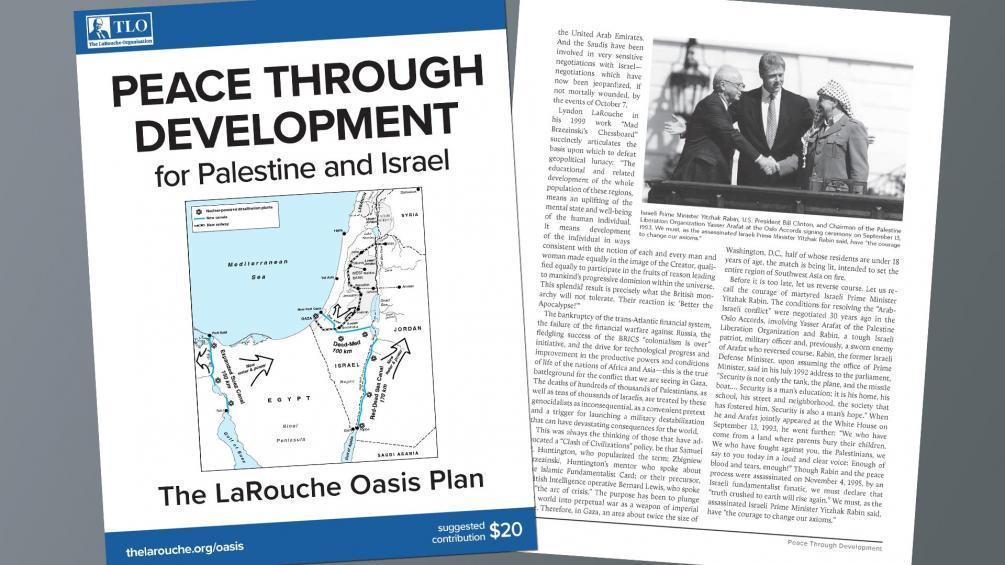
It is now, in my view, the moment where we should all push the Oasis Plan, because Trump has said of himself many times that he is a builder, and he does understand something about construction. . . Building the Oasis Plan, providing fresh new water for all the countries in the region, that one source of conflict would disappear, namely the lack of water. It could inspire the young generation of the Palestinians, and the different Arab countries, Turkey, Syria, Iraq, Afghanistan, the whole region.
Helga Zepp-LaRouche
February 26, 2025.
Gerald Belsky: The agreement that we are calling for is not simply a political agreement for two states, there must be economic development, so that you can give people the idea that this whole region is going to grow and that people are going to have a future. And therefore we’re actually encouraging people to endorse this Oasis Plan. . . . [Belsky describes the plan of U.S. President Dwight Eisenhower for water development across Palestine and Israel. See EIR link.] What do you think of that concept?
Dr. Mubarak Awad: I think it will work. I think that your idea of having an Oasis Plan is necessary not only for the Palestinians, but for the Middle East. It’s a great idea and it will work. Palestinians are not interested in two states/ one state. We are now interested in living in our land. And you cannot live without water. So, your idea of having water for everybody is important. And to have water for drinking, water for all kinds of things, like any human being, in any country in the world, to use water in their homes for everything. That’s an important thing. I don’t think that water should be a political way of dealing with the issue, i.e. if you don’t do this, we will cut the water on you. That’s what we are afraid of. Our president in the United States, Trump, we cannot feel that whatever he says, he means it. And he has said so many things against the Palestinians. He wanted to take Gaza. He will say, no, we don’t want the Palestinians to live in Gaza, all those things. Even if he just says them without meaning, it affects our feeling towards the United States.
And if we say (propose?) an international group, the United States should not be leading that group, because now we don’t trust the United States. From day one when Israel was created, until now, the United States has said, we are for peace, we are for two states. But until now, the United States didn’t reach a point that says, here is our idea of a two-state solution, and it has to be done. Not a single President has said that. And they kept the idea that Israel has to decide, and Israel doesn’t want to decide that. So, we need the international community to mean what they say, and to accept those things as equal. With your idea, Mr. Belsky, you have to include nations other than the United States. You have to include Turkey, you have to include even India. You have to include other countries, even from Africa, rather than just European countries. Because to us, colonization means so much. We are there under the Israelis because of colonization from the West. That’s why we have to feel free to include Pakistan, India and South Africa, and Arab countries. But it has not to be only European. To us, Europeans have been nothing but a disaster for the Middle East.
Belsky: Well, actually, if you look at their current policies in Europe, it’s disaster for every other part of the world. I absolutely agree with you, and . . . we would like to encourage you to make this view that you’re making, known to these other countries, and to the Palestinians and to people around the world, that if we join forces for this policy, we can bring about an actual solution. And that actually is what Helga LaRouche of the Schiller Institute has called a new Security and Development order, that respects the rights and security of all nations, big and small. . . .
Dr. Awad: I recommend one thing for you which is important. And your idea is so important. And we could do it either in Egypt or Jordan or even in Palestine, to have a conference of those ideas of the Oasis Plan that you have in mind. And you could bring people to that from different Arab countries. That’s why Jordan will be the best, because a lot of people don’t want to go through an Israeli security. In Jordan, to have it under King Abdullah or his brother Hassan or anybody in Jordan, and say, we want to have that open for other countries to be invited to it. And people have to not just hear it, but to commit themselves for it.
Belsky: I think that’s a great idea. Maybe we can work together to pull together such a conference.
Dr. Awad: I’ll be more than happy to help you.
March 28, 2024.
“Lyndon LaRouche’s ‘Oasis Plan’ proposes large-scale infrastructure development projects, including the construction of water pipelines and transportation networks, to transform arid regions such as the Middle East into fertile and habitable areas. While the Oasis Plan advocates for ambitious solutions to address regional challenges, its feasibility and potential impact on establishing peace and prosperity in the Middle East are subject to scrutiny. By facilitating the transfer of water resources from water-rich areas to water-scarce regions, the Oasis Plan aims to alleviate water scarcity and promote agricultural development, potentially enhancing food security and economic growth in the Middle East. The construction of transportation networks, energy infrastructure, and other facilities proposed under the Oasis Plan could stimulate economic development, create jobs, and improve connectivity within and between countries in the region.”
Dr. M.K. Bhadrakumar, had a 30-year diplomatic career for India. He served twice in the USSR, and held leading positions within the Foreign Ministry, regarding especially Pakistan, Iran, and Afghanistan. He is a prolific writer on world affairs. His blog is called India Punchline, March 5, 2025.
EIR’s Mike Billington: I’d like to ask you for your thoughts on our Oasis Plan (for all of Southwest Asia). This is a plan that Lyndon LaRouche authored in the 1970s, which was based on the idea that the real problem in the Middle East, that if there was going to be peace, there had to be a concrete development policy which would address the water crisis, as well as the energy and transportation and basic infrastructure. The Oasis Plan is a very ambitious idea of building canals, of building nuclear desalination in order to create huge quantities of fresh water from seawater, and other kinds of infrastructure development, not just for Gaza, but for the whole region, extending out into Iraq and Iran and so forth. I’m wondering what your view of that plan is? We’re trying to intersect this policy debate now, as powerfully as we can, into the discussions that are taking place, because of the Gaza crisis.
Dr. M.K. Bhadrakumar: I think Trump would be interested in this. Logically, Trump would be interested in this. The United States has a handicap. Why is it said that its influence is steadily draining, is losing its capacity in the region. It’s a paradox, but Iran is actually American’s natural ally in that region. The Iranian elite is, again, distinctly pro-Western, and that country is performing today much below its optimal level. It has a huge population, massive land mass and powerful agriculture, a well-developed agriculture base. If only it is allowed to bring out its LNG and gas to the world market, it has a huge reserve. So, you see it can be of use and all these things become possible. But so long as that doesn’t happen — how do you realize these dreams? — they will remain on paper. Because I don’t think any country there has got the kind of intellectual resources, absorption capacity for technology, and the national will and purpose in this way that Iran has. Trump will certainly be attracted towards this if an engagement takes place. I strongly suggest that you should promote an engagement, a constructive engagement between the United States and Iran. And this would be in some ways, I tell you, this would be even, I would say, as significant as the normalization of the Russian-American relationship. It will be in America’s interests.
Col. Richard H. Black (ret.) a U.S. Marine combat veteran and U.S. Army Criminal Law Division at the Pentagon and former Virginia State Senator, U.S.A., February 1, 2025.
“The Oasis Plan can refocus efforts away from the slaughter of war, back toward making Gaza a place where families can live and thrive again.”
“I am Munashe Chiwanza, a civil engineer working in Africa. In association with several technical entities, I received extensive training and my professional certification. The China State Engineering Corporation is one of the firms through which this was accomplished. A broader collaboration between Africa and China promises to assist in building a more prosperous future for the African continent, and its role in the world.
“I fully support the LaRouche Oasis Plan for Peace and Development in Southwest Asia. The region has suffered from long-standing conflicts that have taken a heavy toll on the people living there. It is time for a new approach that focuses on productivity and development rather than geopolitics. I believe that the Oasis Plan offers a promising vision for transforming the region into a place of connectivity, growth, and happiness. Let’s work towards a future of peace and prosperity for all in Southwest Asia.”
“In the view of Twin Cities Nonviolent and myself, Fr. Harry Bury (a member of the Association of US Catholic Priests), we believe that the positive “Oasis Peace Plan” through development, promoted by the Schiller Institute, are congruent with the BRICS (Brazil, Russia, India, China, South Africa, et al.) as for nations of the world to cooperate and cease competing with each other. Both are seeking to achieve similar goals.
“Peace will come from nations helping each other develop.
“We need individuals and groups to get the U. S. politicians to cooperate with the BRICS nations and promote the Oasis Peace Plan.”
“I support the Oasis Plan and I’ll leave it at that.”
“The Oasis Plan needs to be introduced as part of a broader peace plan. However fine an idea it has been, the fact is that the local rivalries and particularly rivalries projected by the United States in a Cold War mode has made regional cooperation all but impossible. Syria, for example, would need to figure quite seriously, or Iraq for that matter, the Tigris and Euphrates. All of these states would need to figure very seriously in any kind of regional water plan. But that’s been impossible when the United States has been at war with Iraq for a long time. In the past, Iraq was seen as the enemy. We can’t deal with Iran because they’re the enemy. Syria was seen as hostile to the US, so we couldn’t deal with Syria. I think it’s only as you begin to see a motion, a movement towards broader regional cooperation that the water aspect, the engineering aspects, the power aspects, the social aspects, the political aspects really begin to come into play.
“The first very positive move in that direction, as you’re well aware, was that the so-called intractable hostility between Persians and Arabs, was essentially solved or mollified by Chinese intervention. A couple of years back, when they brought about a rapprochement between Saudi Arabia and Iran, that was a remarkable event that many regional specialists would have said could never happen. So you can see the power of where serious political geopolitical thinking opens the door to the more practical aspects of broader regional water, agricultural, hydrological projects can find a place. So, I think maybe the day is getting closer when this project could be seen as feasible and manageable.”
“Dear Sir, Thank you for sending me the digital version of your project to promote Israeli-Palestinian peace through concrete initiatives. The issue of water is vital and plays an important role in crises and conflicts. You’re quite right, as I wrote in my last book, Western countries would do better to boast about selling desalination plants than increasingly sophisticated armaments…
“As an economist and geopolitician by training, I don’t have the technical skills to judge the material feasibility of your “Oasis Plan” project. But with my long and rich experience as a senior international civil servant, I salute and lend my full support to the spirit that presided over the formulation of this project for the fair sharing of water and energy resources.
“In various forums and essays, including an article to be published shortly, I have consistently advocated the creation of a Palestinian state on Palestinian soil. The creation of this entity is a vital necessity not only for the Palestinian people, but also and above all for the Israeli people. It is futile to think that without a “two-state” solution, these two peoples will be able to rediscover the joys of daily life. I surely will circulate your document among my acquaintances and wish you every success in your fight for the peaceful coexistence of the Palestinian and Israeli peoples.
“Sincerely, Dr Ninou Garabaghi, Essayist, former senior international civil servant”
“Hi, My name is Jack Gilroy and I’m with Pax Christi Upstate New York, and USA Pax Christi, as well as Peace Action, and a field representative for Veterans for Peace. I think there’s a great opportunity here for the Trump administration to take action on the Oasis Plan.
“If you don’t know what the Oasis Plan is, in a nutshell, it’s to make green again, the Middle East, which was many thousands of years ago, a green, productive place. Aquifers are burning out, are wearing out. We don’t have the energy right now to turn the salt water into fresh water. But that can come with new advances in alternative energy, wind, the tides, solar planning, can turn the salt water into rivers of fresh water. Rivers that will run in justice for all the people and make it green again.
“That’s possible, in that Mr. Trump, who likes to win situations, has the best opportunity of all of making this happen. How does it happen? It happens by not sending weapons to Israel. It happens by telling Israel we will not aid them any further unless they allow Palestine people to be free, to establish a free Palestine.
“So, Mr. Trump, the administration, the Republicans, here’s your opportunity. The crisis, of course, is an opportunity according to the Chinese. And so let the Chinese chime in as well. The Chinese philosophy is that in every crisis, there’s an opportunity. Here you go, guys. Let’s do it. Oasis plan for the Middle East.”
“The Oasis Plan presents a unique opportunity for the good citizens of the world to actively contribute to a lasting solution to the decades-long conflict in Palestine. For years, people from all corners of the globe have voiced their outrage, condemning the violence, protesting both online and in the streets. But condemnation alone is not enough. It is time for a shift from reaction to action. Now, more than ever, we must come together to organize, propose, and implement tangible solutions for the sake of humanity.
“The Oasis Plan offers precisely that, a blueprint for economic development that prioritizes the well-being of those affected by this ongoing crisis. By providing economic stability and infrastructure development, it not only provides a pathway to prosperity but also restores hope, dignity, and the fundamental right to life. This is crucial because the war in Palestine has persisted largely due to a blatant disregard for human life—something that is unacceptable, especially in our modern world.
“A just and peaceful future cannot be achieved through conflict, nor can it be sustained through mere words of sympathy. It requires bold, strategic initiatives like the Oasis Plan, which aim to uplift communities, bridge divides, and establish a foundation for enduring peace. Supporting and advancing this vision is not just an act of solidarity, it is a moral imperative for all who believe in justice, humanity, and a better world.”
“I would like to start my speech by giving a brief synopsis about the Oasis plan, because later, my discussion or deliberation will be about the Palestinian-Israeli conflict and how that will be in the context of a plan that will really bring peace, security and justice through economic development, and through ties between North and South and what have you. And allow me to start by shedding a brief light on the Oasis Plan, sponsored by the Schiller Institute under the title “LaRouche Solution for Peace through Development between Israel and Palestine and for all Southwest Asia”. Peace through economic development is the only successful basis for lasting just peace in the Middle East region. There is no purely military basis for peace or security, and military solution has never been a solution. So, there is no purely military basis for peace or security. Only development is essential. However, the greatest impediment to development in our region, which is the Middle East region and Southwest Asia, is the shortage of fresh water. As everybody knows, because if we don’t solve this problem, the next war in the Middle East is going to be over, water resources. And through the construction of a network of desalination plants, ideally nuclear powered, that could turn the seawater into fresh water.
“These plants could connect the Red Sea with the Dead Sea and the Dead Sea with the Mediterranean as it is outlined in the plan. And it will only come about by rejecting power politics, rejecting geopolitics, and building a new paradigm shift of international relations that is based on a new concept of economic development, i.e., will prevail security and development. As Helga Zepp-LaRouche once said, I’m quoting, “You have to have hope and give the youth a decent future, to have a normal life of doing useful things”. This plan should be applicable to the Palestine-Israel conflict, for its finality and for its duration of longevity, for peace and security.”
“Pope Paul VI in his 1967 encyclical letter Populorum Progressio famously wrote, ‘The new name for peace is development,’ which is equally true today. The Oasis Plan, which is being proposed for the development of Gaza by the Schiller Institute, is such a plan because true peace cannot be achieved without addressing economic and social inequalities.”
“Many countries of the world need a more intelligent and stronger leadership, than they currently have. Leaders have been far too dominated by ridiculous theories and beliefs of the extreme left-wing, who do not have to face the reality of building a real world.
“The world population is currently increasing, and also, moving up the social brackets. That means that they need more and more fresh water. God and Mother Nature are not going to cause more rain to fall. It is pointless imagining that you can just ‘collect more water’ from wherever.
“Here in South Africa, we have minimal freshwater inland, but we have the entire Indian Ocean and Atlantic Ocean which we can use. The country has to plan for 100% increase in water consumption. This is not going to come from natural rainfall. We have no option but to use the oceans, and for that we need to desalinate.
“An ideal mechanism for desalination is nuclear power, specifically Small Modular Reactors, which can be placed strategically at many points.
“Plans such as the Oasis Plan should be applauded. We need worldwide intellect to address the real problems of living in our modern world, and not all these emotional and imaginary issues of left-wing people who don’t actually advance the lifestyle of anybody.
“Engineering good sense must come to the fore.”
“Endorsement of the Oasis Plan by the Schiller Institute
“The conflict in the Middle East, particularly between Israel and Palestine, can be resolved through the Peace Through Development approach proposed by the LaRouche movement.
“Humanity is the only species that possesses creative powers of mind. It is imperative that through our determination we work to use these powers of mind to improve ourselves and advance the physical conditions of life for people worldwide.
“It is imperative that we strive to cultivate and instill the concept of direct non-violent resistance throughout our society; no person should suffer abuse, be exposed to violence, or view the use of violence as acceptable.
“The Oasis Plan offers a path forward to foster cooperation among opposing interests and address a need common to everyone in the region: access to clean and abundant sources of water and power.
“This approach can well be applied to other conflict-ridden regions, particularly in Africa, where the effects of colonialism and neocolonialism still loom large. Africa needs development and development is the road to peace.”
“In praise of the Oasis Plan– After receiving my doctorate at the University of Leiden, making a name for myself in melting and freezing of helium isotopes, I wanted to help the Third World through physics. Malawi was interested in having me, though the university there still needed to be built. My advisor persuaded me to go to Lebanon instead, where I could work at the American University of Beirut.
“Soon I came to the conclusion that the Palestinians had been wronged; but I also understood that revoking Israel’s right to exist would be the exact same mistake, another decision made without regard for the people who lived there, built the land, and were born there.
“Imagine my delight many years later, nearing the end of my life, to find the Oasis plan, newly proposed by Helga Zepp LaRouche, that would help both sides recreate the land abundantly provided by God with milk and honey.”
DELIVERED AT THE SCHILLER INSTITUTE CONFERENCE IN BERLIN, THE FEDERAL REPUBLIC OF GERMANY DURING PANEL 1: THE COOPERATION BETWEEN BRICS AND EUROPE FOR THE REALIZATION OF THE OASIS PLAN AND AGENDA 2063 FOR AFRICA
I. OPENING: A NEW DAWN FOR HUMANITY
It is with profound gratitude and a deep sense of duty that I accept the honour to address this august assembly under the rallying cry, “Man is not a wolf to man.” In that singular declaration lies the repudiation of cynicism and the reaffirmation of a timeless truth—that our shared humanity must transcend the boundaries of geography, ideology, and history. That indeed, the arc of history can still be bent toward justice, if only we summon the courage to act.
Today, I speak as an African. But I also speak as a citizen of the world. A world bruised by conflict, suffocated by inequality, and imperilled by a dangerous inertia of inaction. From the charred ruins of Gaza to the smouldering silence in Sudan, from the swelling tides of forced migration to the silent cries of youth locked out of opportunity—this moment calls not for more lamentation, but for a renaissance of will. A new dawn for humanity.
We assemble here, not as strangers huddled in fear of the unknown, but as kindred souls joined by the sacred duty to preserve human dignity. The theme before us— “Cooperation between the BRICS and Europe to implement the Oasis Plan and the Agenda 2063 for Africa”—is not a footnote in the script of diplomacy. It is the preamble of a new chapter, one in which old antagonisms give way to new alignments built on equity, respect, and vision.
For decades, Africa has stood at the crossroads of promise and paradox. Rich in resources, yet impoverished in returns. Brimming with youth, yet bleeding from neglect. It has been the theatre of competing interests, but seldom the stage for true partnership. Today, we must reimagine that story.
Let us be clear: The cooperation we seek is not one forged in charity, nor in guilt. It is a partnership rooted in enlightened self-interest, in the recognition that Africa’s rise is not a threat to the world—it is the salvation of it. For when Africa thrives, the world breathes easier. When her deserts are greened, her youth empowered, her potential unlocked, the global South stands taller, and the global North more secure.
Let this conference, convened in the heart of Europe, be remembered not merely for its speeches, but for the spirit it stirred. A spirit that dared to believe that BRICS and Europe, once divided by paradigms of power, can be united by a common project of peace and prosperity. That water can flow where once there was sand. That energy can be harvested where once there was waste. That dignity can bloom where once there was despair.
And so, let us proceed not as spectators of history, but as its authors. Let us recommit to the ancient truth that binds all great civilizations: that to build is greater than to conquer, and to cooperate is more enduring than to dominate.
II. CONTEXTUAL BACKDROP: AFRICA AND THE WORLD IN THE EYE OF THE STORM
To understand where we stand today, we must remember where we have come from. The 20th Century carved deep grooves into the fabric of international relations—grooves whose contours still shape the terrain we now navigate.
Africa’s story cannot be disentangled from the long shadow of colonialism. Its borders were drawn in Berlin in 1884, not by its peoples, but by foreign powers whose goal was not unity, but extraction. Its institutions were built not for development, but for domination. When independence came, it did so with broken economies, borrowed systems, and the psychological remnants of subjugation.
In the wake of this global upheaval, the Non-Aligned Movement emerged as a voice of the dispossessed and the determined. Leaders such as Sukarno of Indonesia, Josip Broz Tito of Yugoslavia, Jawaharlal Motilal Nehru of India, Gamal Abdel Nasser of Egypt, and Kwame Nkrumah of Ghana dared to chart a third way—neither East nor West, but a world order rooted in sovereignty, solidarity, and justice. They rejected the idea that the newly independent nations must remain satellites in the gravitational pull of Cold War giants. They gave voice to the Global South before it had a name.
But their dream struggled against the reality of a bipolar order that divided the globe into neat ideological lines—lines policed by missiles, spies, and sanctions. The world was organized around spheres of influence, proxy wars, and calculated silence. Africa, Latin America, Southeast Asia—these were not chess players, but chessboards. And now, that bipolarity is gone—but what has replaced it?
We have entered a period we are told is multilateral, yet it is riddled with contradictions. On paper, new institutions exist—the United Nations, the African Union, the International Criminal Court, the World Trade Organization. Yet in practice, they are often unable to enforce their decisions or deliver justice. They bend beneath the weight of geopolitics.
The Rome Statute, which birthed the International Criminal Court (ICC), was meant to be a beacon of accountability. Yet it has become a symbol of selective justice. Rodrigo Roa Duterte of the Philippines was summoned, and Dominic Ongwen of Uganda stands convicted. Yet George W. Bush and Tony Blair, under whose leadership the war in Iraq unfolded—without UN sanction and at the cost of hundreds of thousands of lives—remain untouched, unprosecuted, and unrepentant. Where is the equality of nations in this?
Today, the world is not defined by clarity—but by confusion. We speak of multilateralism, yet act with unilateral impulse. We preach peace, yet profit from arms. We write charters, yet violate them at will. The architecture of global governance is creaking under the weight of hypocrisy.
This is the disordered world in which Africa must find her place. And she must do so not by imitation, but by innovation. By forging partnerships that transcend the broken legacies of empire and Cold War blocs. By demanding not just reform of global governance—but its re-founding on principles of fairness, transparency, and shared destiny.
Africa does not seek to join a table where others dine as kings and she serves as guest. She seeks to co-own the table—or build a new one, if need be.
Let the Oasis Plan and Agenda 2063 be the blueprints for such a table. Let BRICS and Europe be the hands that help shape it—not in charity, but in solidarity. Not in confusion, but in a new clarity of purpose.
III. THE OASIS PLAN: VISION AND PRACTICALITY
The great paradox of our age is that we live in a world of abundance, yet millions still perish for want of water, food, and energy. Nowhere is this contradiction more pronounced than in Africa and the broader Global South—regions where deserts expand even as ideas remain buried, and where resources abound even as their distribution remains scandalously unequal. But what if we dared to imagine differently?
Enter the Oasis Plan—a bold and prophetic vision first articulated by Lyndon LaRouche and long championed by this very Institute. A plan rooted not in the arid language of austerity or technocratic detachment, but in the fertile imagination of possibility. At its core, the Oasis Plan proposes a radical yet practical proposition: to transform the deserts of the world—not metaphorically, but physically. To green barren lands, to irrigate dry valleys, to build new rivers across sand and silence.
More than a water project, the Oasis Plan is a civilizational call—to harness modern science, infrastructure, and transcontinental cooperation to achieve what previous generations only dreamed of. It proposes the creation of inter-basin water transfer systems, vast irrigation schemes, integrated transport corridors, and energy grids that cross borders and bind nations. It envisions not merely adaptation to climate change, but mastery over it. Not merely survival in harsh terrains, but their transformation into engines of productivity.
For Africa, this vision is not foreign. It resonates deeply with the continent’s own historical yearnings and blueprints for regeneration. Consider the ambitions of Agenda 2063: to end hunger through agro-industrialisation; to create smart cities and resilient communities; to build infrastructure that connects Cape to Cairo. The Oasis Plan and Agenda 2063 do not
compete—they complement. The former offers a powerful mechanism to fast-track the latter.
But let us be candid: such a project is not for the timid or the cynical. It will require capital— yes—but also coordination, political will, and trust among nations. It will demand breaking free from colonial maps that artificially divided us, and forging new ones that are drawn by common purpose. It will require engineers and ecologists, financiers and farmers, diplomats and dreamers, all working in concert.
Some will ask: is it feasible? To them, we say—what is the alternative? More food insecurity? More forced migration? More wars over water and pasture? Some will say: it is too ambitious. To them, we respond with the wisdom of Africa’s own Kwame Nkrumah: “We face neither East nor West; we face forward.”
Indeed, the Oasis Plan is not merely feasible—it is necessary. For Africa’s deserts are not empty—they are full of waiting. Waiting for investment. Waiting for justice. Waiting for the moral imagination of humanity to match the technological capacity it already possesses.
Let us then seize this moment. Let us not view the desert as a graveyard of hope, but as the birthplace of a new development ethic. Let the Oasis Plan become the pivot around which a new partnership between BRICS, Europe, and Africa is forged—not out of pity, but from shared possibility.
For where water flows, peace follows. Where green emerges, hope returns. And where nations cooperate, civilizations endure.
IV. AGENDA 2063: AFRICA’S BLUEPRINT
If the Oasis Plan is the infrastructural artery, then Agenda 2063 is the beating heart of Africa’s collective vision. It is the continent’s bold, unapologetic declaration that it will no longer be content to survive on the margins of global affairs. It will thrive, lead, and shape the 21st Century.
Conceived in the 50th Anniversary year of the founding of the Organisation of African Unity, Agenda 2063 is not merely a policy document—it is a manifesto of transformation. It speaks to the Africa we must become: integrated, prosperous, peaceful, governed by democratic principles, respectful of human rights, and driven by the creative energies of its own people.
It articulates seven aspirations, each a pillar upon which the continent hopes to build its renaissance. These include:
- A prosperous Africa based on inclusive growth and sustainable development;
- An integrated continent, politically united and based on Pan-African ideals;
- An Africa of good governance, democracy, and the rule of law;
- A peaceful and secure Africa;
- A culturally vibrant Africa with strong identity and shared heritage;
- An Africa with people-centered development, especially for women and youth;
- And finally, Africa as a strong, united global player and partner.
These are not idle dreams. They are anchored in 20 concrete flagship projects—ranging from the African Continental Free Trade Area, to the establishment of a single African air transport market; from the construction of a high-speed railway network, to the silencing of the guns across the continent.
But, distinguished delegates, we must confront a hard truth: the road to 2063 is strewn with challenges.
Corruption and governance deficits persist. Conflict still simmers in too many places. Infrastructure gaps remain yawning. Youth unemployment, rising debt burdens, illicit financial flows, and climate vulnerability all threaten to derail this journey. And beneath it all lies a deeper structural obstacle—Africa is still too often seen as a site of charity, not of investment; a place to extract from, not to build with.
This is why the conversation today is so crucial. Agenda 2063 cannot be realised through African effort alone. It demands partners—genuine partners—who see Africa not through the lens of paternalism or conditionality, but through the lens of mutual gain and respect. Partners who understand that development is not a transactional gift—it is a human right. It is justice.
In this regard, the role of BRICS and Europe becomes pivotal. Africa does not seek a new coloniser in the East or a nostalgic benefactor from the West. It seeks co-builders. Those who will help scale up renewable energy, digitize economies, transfer technologies, open markets, and—crucially—respect Africa’s right to define her own path.
Agenda 2063 is a grand vision, yes—but it is also a litmus test. A test of whether the world is willing to invest in peace over weapons, in infrastructure over interference, in solidarity over suspicion.
Africa is ready. The blueprints have been drawn. The youth are awake. The women are mobilised. The minds are bright. But no architecture stands without steel. And no future is built alone.
Let this be the hour when BRICS and Europe rise to the occasion—not with speeches, but with solidarity. Not with promises, but with projects. Not with prescriptions, but with partnership. Because the Africa that Agenda 2063 envisions is not just an African dream. It is humanity’s hope.
V. BRICS AND EUROPE: POTENTIAL FOR CONVERGENT COLLABORATION
If history is a river, then this moment is a confluence—a meeting of currents long flowing apart, now converging toward a common horizon. For too long, BRICS and Europe have been portrayed as opposites: one, the voice of the emergent South; the other, the custodian of an aging order. One, seeking multipolarity; the other, defending the architecture of yesteryears.
But perhaps this dichotomy is not only outdated—it is dangerous. Because the crises we now face—climate instability, food insecurity, pandemics, mass displacement, technological inequality—do not respect geopolitical rivalries. These are not problems for the East or the West, for the North or the South. They are problems for humanity. And their solution demands nothing less than a moral convergence. That convergence can begin in Africa.
Africa offers a unique opportunity—a moral frontier, an economic frontier, and a geopolitical bridge. It is where the ambitions of BRICS and the anxieties of Europe intersect. BRICS sees Africa as a partner in building a new economic architecture rooted in sovereignty, solidarity, and infrastructure-led growth. Europe, too, increasingly recognizes that its own stability, security, and demographic balance are linked to Africa’s fate.
The question, then, is not whether BRICS and Europe can collaborate—but how they will choose to do so.
Let us begin with the most obvious point of synergy: infrastructure investment. Africa needs over $100 billion annually to close its infrastructure gap. BRICS, through the New Development Bank, and Europe, through the European Investment Bank and the Global Gateway initiative, can co-finance regional projects—railways, digital corridors, energy pipelines—that are Pan-African in scope and transformative in effect.
Secondly, we must talk about technology transfer and innovation diplomacy. Let BRICS bring its manufacturing know-how, its fintech revolutions, its pharmaceutical capabilities. Let Europe bring its clean energy innovations, its research institutions, its education platforms. Together, let them support African universities, research centres, and startups to leapfrog the industrial stages that others had to crawl through.
Third, there is room for deep cooperation in the water-energy-food nexus. The Oasis Plan, as we have said, requires technical expertise, satellite monitoring, hydrological modelling, and climate-smart agriculture. This is a field where Europe’s engineering heritage and
BRICS’ practical experience can together deliver results—green corridors, smart irrigation, and regional food reserves.
Fourth, we must speak of peace and security. No development can flourish in the shadow of war. Let BRICS and Europe support African-led peacekeeping and conflict resolution mechanisms—not by imposing solutions, but by funding and equipping regional and continental bodies like the African Union Peace and Security Council and ECOWAS. Let external powers support African agency, not supplant it.
And finally, let us institutionalize this partnership. We propose the creation of a BRICS– Europe–Africa Trilateral Forum for Development and Cooperation, a platform where projects are jointly identified, financed, and evaluated. A place where ideas are traded, not ideologies imposed. This is not utopia. It is geopolitics reimagined through the prism of justice.
Let us reject the zero-sum logic of blocs. Let us break the monopoly of narrative that says development must always wear the badge of one flag or another. Let us write a new grammar of cooperation—one that honours Africa’s sovereignty, unlocks her potential, and dignifies her people.
For in doing so, we will not merely be investing in a continent—we will be rescuing the very idea of global solidarity.
VI. THE MORAL IMPERATIVE: DEVELOPMENT IS A RIGHT
There is a silent cry rising from the streets of Juba, the villages of Ituri, the deserts of Mali, and the informal settlements of Lagos. It is not merely a cry for aid—it is a demand for justice, for recognition, for dignity. And at its core, it is the simplest, yet most revolutionary claim: Development is a right.
Yet this right, like so many others, has been unevenly applied and frequently denied. We live in a world where laws exist but justice retreats. Where institutions pronounce great ideals, but recoil when they are most needed.
Look no further than the United Nations—born from the ashes of a world war, tasked with preserving peace, promoting cooperation, and defending human rights. Yet today, the Security Council is paralysed by vetoes. Resolutions are passed, then ignored. Sovereignty is trampled in the name of security, while the powerful remain immune to the rules they demand of others.
Turn to the African Union—a noble inheritance of our Pan-African forebears. But it, too, suffers from institutional anemia—unable to compel member states to act, to prevent coups, or to resolve conflicts without external mediation. Its decisions often gather dust while violence festers.
And what of international justice? The Rome Statute, we were told, would usher in an era where no leader could act with impunity. Yet it has become an instrument of geopolitical theatre. Dominic Ongwen, a child soldier turned warlord, sits in The Hague—his guilt undeniable, his trial legitimate. Rodrigo Duterte was rightly scrutinised for extrajudicial killings.
But where, then, is the indictment of George W. Bush and Tony Blair—the architects of a war in Iraq that flouted international law, destabilised an entire region, and led to a humanitarian catastrophe whose effects are still felt today? Where is the warrant for those who carpet-bombed truth in the name of democracy? The message is unmistakable: there is one justice for the weak, and another for the strong. This is not justice. It is jurisprudential apartheid. It is hypocrisy masked as principle.
And all the while, Africa is told to “trust the system.” To reform within rules it did not write. To participate in a multilateral order that treats her voice as decoration rather than directive.
The result? A world adrift in moral confusion. Multilateralism has become a maze of contradictions. We speak of a “rules-based order,” but whose rules? Whose order? Why do the rules bend when certain flags wave? This cannot continue.
Development, peace, and justice must not be traded for geopolitical convenience. They must be entrenched as the ethical bedrock of our global engagement. And this begins with recognising the full humanity, the full agency, and the full equality of the African peoples.
We must demand a new multilateralism—one that is not a stage for power rivalry, but a sanctuary for cooperative progress. Let BRICS and Europe rise to this challenge—not merely as financiers, but as co-defenders of a fairer world. Let them support African-led institutions without interference, and uphold universal justice without exemption.
And let Africa speak with one voice, grounded in her history, emboldened by her youth, and unwavering in her demand: We will not accept development as charity, nor justice as favour. We claim them as our right. Because without justice, peace is a lie. Without equality, development is deception. And without courage, history will continue to repeat itself.
VII. A CALL TO ACTION: FROMCONFUSION
TO CONSTRUCTIVE COOPERATION
It is no longer enough to diagnose the world’s disorder. It is time to design the remedy. For while the institutions of global governance stumble—paralysed by politics, weakened by inconsistency, and corroded by double standards—we must not be immobilised by their confusion. History has shown us that when old orders decay, new ones must be forged— not feared.
Let this moment, then, not drift into the annals of forgotten declarations. Let it be the beginning of a new movement—from rhetorical solidarity to structural cooperation, from handshakes to hand-built futures.
First, I propose the creation of a Trilateral Commission on Equitable Development, jointly stewarded by BRICS nations, the European Union, and the African Union. Its mandate? To align the Oasis Plan and Agenda 2063 into an actionable framework—with agreed timelines, budget commitments, and continental ownership. Let it be headquartered in Africa, staffed by Africans, and accountable to Africans—yet supported with the full strength of global partnership.
Second, we must convene a New Bandung, a modern summit of formerly colonised and currently marginalised nations—joined not only by the historic leaders of the Global South, but also by those from the Global North who have the humility to listen and the courage to co-create. Its goal? To redefine multilateralism—from a privilege of power to a platform for shared humanity.
Third, let us establish a Global Observatory for Justice and Accountability, to monitor the application of international law and expose selective prosecutions and impunity. Let us demand that no nation, no matter how powerful, be above the norms it proclaims. Let international justice be blind not to race, region, or rank—but to bias.
Fourth, I urge the African Union to launch a Continental Compact for Institutional Sovereignty—an initiative to strengthen the enforcement capacity of African institutions, curb dependence on foreign donors, and assert the principle that no policy imposed from abroad shall override the will of African peoples.
Fifth, let us invest in narrative sovereignty. For ideas shape policy. And so long as Africa is spoken about but not spoken with, we shall remain peripheral to the decisions that define us. Let this new alliance support African media, African research centres, and African cultural institutions—to retell our story, in our own voice.
To BRICS: You have stood as a counterweight to unipolarity. Now stand as a co-builder of a new plurality—one based not on confrontation, but on constructive convergence.
To Europe: You have the chance to be more than a repentant coloniser. Be a regenerative partner. Not by funding pilots that never scale—but by betting, boldly, on Africa’s full ascent. And to Africa: Speak not in whispers, but in symphonies. The time of strategic patience is over. This is the hour of strategic assertion.
We can no longer afford to wait for the world to organise itself justly. We must organise ourselves justly—and invite the world to meet us there. In this season of institutional decay, let us be the architects of institutional rebirth. In this moment of geopolitical confusion, let us be the clarifying force. And in this crossroads between cynicism and courage, let us choose courage.
VIII. CONCLUSION: TOWARD A NEW HUMAN RENAISSANCE
As we close this dialogue, we must confront a fundamental truth: the world, as it is, is no longer enough. It no longer protects the weak, restrains the strong, or inspires the hopeful. It is a world groaning under the weight of its own contradictions—championing peace while profiting from war, preaching justice while practising impunity, promising multilateralism while practicing monopolies of power.
We are gathered here under the theme “Man is not a wolf to man.” Let us hold fast to that creed—not as mere rhetoric, but as a radical proposition in an age where civility is endangered, and solidarity is rare.
We have recalled the legacy of colonialism, and the courageous refusal of its heirs— Sukarno, Nkrumah, Nehru, Tito, Nasser—to accept a world ordered by dominance. We have traced the effects of the bipolar order, which reduced the Global South to proxies in ideological contests that were never ours. We have entered an age declared as multilateral, but experienced as muddled and compromised.
We have spoken of institutions—once heralded as humanity’s greatest hope—which now waver in the face of realpolitik. We have seen how the Rome Statute, intended to end
impunity, is weaponised unevenly, punishing the poor while shielding the powerful. And yet, even as the old order fractures, the opportunity to build anew arises.
The Oasis Plan and Agenda 2063 are not just development strategies. They are moral blueprints. They invite us to reroute the flow of history—to irrigate deserts both literal and institutional, to green not only barren lands, but barren systems. They call us to build infrastructure with dignity, institutions with integrity, and partnerships without hierarchy.
Let us, then, be the generation that gave new meaning to multilateralism—not as a theatre of privilege, but as a home of shared governance. Let us be the generation that rose from the ruins of broken promises and declared: no more false partnerships, no more two-speed justice, no more dialogue without decision.
Let us be the generation that proved that Africa was not the problem to be solved—but the partner to be trusted, the engine to be empowered, and the voice to be heeded. Let the BRICS and Europe not meet across the battle lines of history, but across the blueprints of shared humanity. Let us raise institutions worthy of our ideals. Let us build systems as noble as our speeches. Let us walk away from this gathering not merely inspired, but obligated—to act with vision, to speak with moral clarity, and to build with fierce compassion.
For in the end, history will not remember the documents we filed or the communiqués we issued. It will remember whether we rose to the moment, or shrank before it. Whether we chose to cooperate—or to continue the chaos.
Let us choose cooperation. Let us choose courage. Let us choose to build a world in which no child drinks from a poisoned river, no leader escapes justice by passport, and no continent is left behind.
This is the renaissance we must dare. This is the justice we must deliver. This is the future we must build.
LIST OF REFERNCES
implementation-plan-2014-2023 accessed 10 July 2025
July 2025
- European Commission, Global Gateway: Europe’s Strategy to Connect the World
(2021) https://international-partnerships.ec.europa.eu/policies/global-gateway_en
accessed 10 July 2025
- Helga Zepp-LaRouche, The Oasis Plan: Peace Through Development (Schiller Institute, 2023) https://2.schillermeet.de accessed 10 July 2025
- Julius Nyerere, ‘Development is for Man, by Man, and of Man’ (Speech at the South Commission, 1987)
- Kwame Nkrumah, Africa Must Unite (Heinemann, 1963)
- Lyndon H LaRouche, The New Silk Road Becomes the World Land-Bridge
(Executive Intelligence Review, 2014)
“I support the OASIS plan, as it offers a path to peace, stability and prosperity for the people of Palestine after years of Occupation and oppression. This initiative has the potential to bring hope for change and should be supported by the regional countries and international community.”
“I believe the world has a chance for a better and brighter future through the LaRouche Oasis Plan. The implementation of this Plan will greatly cause a leap upward in the lives of people in Southwest Asia and beyond.”
“I fully support the OASIS plan, as it offers a path to peace and prosperity for the people of Palestine after years of hardship and oppression. This initiative has the potential to bring lasting change and should be embraced by nations worldwide, both developed and developing. LaRouche was truly a visionary leader”
“I have reviewed the [LaRouche] Oasis Plan, a very good presentation, both in text and in video. Yeah, I support [the idea] to have a different approach, in vying to solve wars, crises in the world. I think the approach the LaRouche Organization is taking is the right direction. When you factor beyond mediation, beyond of course diplomatic discussions, and examine the root cause – sometimes [the possession or lack of] resources is fundamentally behind wars and behind the conflicts. The idea of creating resources, mobilizing for desalinating water, generating electrical power, and helping to build up Palestine along with a Two-State solution is something that I endorse.
“Many conflicts and wars arise when an attempt is made to deny resource-rich countries the opportunity and right to develop a full array of refining, manufacturing skills and technologies. This can also affect the mental outlook of people. This approach [Oasis Plan] is one which can be taken up with other countries and can serve the world.”
“I am Robert Alexander Oklejas, past president of Pump Engineering, Inc PEI), a leading supplier of desalination pumps and energy recovery hydraulic turbochargers for large scale reverse osmosis desalination plants. PEI equipment is installed in some of the world’s largest RO desalination plants, with plant capacities of up to 500,000cubic meters per day of potable water production.
I wholeheartedly endorse the LaRouche Oasis Plan. It is technically feasible. The discussion by Dr. Vincenzo Romanello should be our guide to a modern implementation of the Plan. The necessary nuclear and desalination equipment is well developed and reliable.
The “need” for water is there. Water will be the basis of development of the economy of Palestine/Israel. The solution to this need is at hand. All it takes now is a shared sense of destiny and a healthy dose of cooperation.
I wish all the best for the LaRouche Oasis Plan.
“The world has evolved into a very dangerous and fragile time. Tensions have continued to rise between the western powers led by the United States and the United Kingdom. It’s the west versus the rest as the majority of the world is seeking to build cooperation and promote international development. The Middle East remains a key focal point that could easily escalate. It is time we step back from the brink of the abyss. It is time to come together jointly, leveraging our combined scientific and economic capabilities to truly plant the seeds for economic development and global peace.
“A foundation for economic development is ready access to water and energy. The Schiller Institute’s proposed OASIS Plan provides a foundation and a vision. It seeks to develop rivers of fresh water across the deserts. The OASIS Plan calls for nuclear powered energy stations to power multiple desalination facilities to provide fresh water. This acts to provide these pillars providing ready access to affordable clean energy and plentiful potable water thus enable societies to develop and prosper. Such a concept calls for a global joint effort but provide a vision much brighter than what we see on the horizon today. I strongly support the OASIS Plan concept and we need to actively work together to see through its implementation. Peace, Not War!”
Helga Zepp-LaRouche: It is now, in my view, the moment where we should all push the Oasis Plan, because Trump has said of himself many times that he is a builder, and he does understand something about construction, and he wants to get the economy going for the United States. Maybe if we all would work together to convince him to promote the Oasis Plan, and also talk to all the neighboring countries of Israel and Palestine, and lay out what we try to do with our conferences on the Oasis Plan and the videos we have made, maybe it would inspire the different leaders of the region.
For example, Saudi Arabia is building a ski resort in the desert. I think the temperatures go up to 40, 50 degrees (Celsius), but they are building a ski resort for people to do skiing there. Well, that costs an enormous amount of money. I would think that if one would think about building the Oasis Plan, providing fresh new water for all the countries in the region, that one source of conflict would disappear, namely the lack of water. It could inspire the young generation of the Palestinians, and the different Arab countries, Turkey, Syria, Iraq, Afghanistan, the whole region.
And I think, we should really put this perspective of development massively on the table because, frankly, I think that a new global strategic, security and development architecture, which involves every country on the planet, is where we have to go. I think for the region of the Middle East, the Oasis Plan is right now, the one thing which would change the dynamic. So, I would suggest that we discuss that in the course of this session of the IPC. And if people agree with that, maybe we can make a mobilization out of that as well. What do you think?
Scott Ritter: Look, I’m, I’m open to any to work with anybody who’s responsibly and with genuine intent, looking for a peaceful outcome. The Oasis Plan should be developed further and given a shot. So, consider me to be a tool in your tool chest, and, I’ll help you out any way I can.
Larry Wilkerson: I would say the same thing. I think the Saudi ski resort is sort of like salmon fishing in Yemen, if you remember that movie in that book. It’s money to satisfy some prelates and some high-ranking royals, but it doesn’t do anything for the region and even ultimately for Saudi Arabia. And you’re right to put your finger on water. Water is critical in that region. And one of the reasons that actually, you can understand partly what Israel has done with regard to Lebanon and elsewhere is their search for water. It’s going to become even more critical as climate change wreaks more of its havoc. So yes, I would be absolutely for that.
Zepp-LaRouche: We have had two conferences on the Oasis Plan top ambassadors from Palestine, from South Africa, many other countries and they all committed themselves to promote this idea. So maybe if we would recontact all the people we’d already worked with on the Oasis Plan, that we really try to put it on the agenda. And the best thing would be to immediately convene a conference in the region inviting all the countries to participate. If we all work towards that goal we may be able to accomplish it.
“I strongly support the pioneering vision of Lyndon and Helga LaRouche for global development and advocate for its implementation to foster progress and shared prosperity. As a PhD in nuclear engineering with extensive experience in the field, I believe it is essential to promote the advancement of peaceful and cutting-edge nuclear technology worldwide, with particular emphasis on the Middle East, in line with the vision outlined in the Oasis Plan.
“This initiative provides a concrete solution to ensure the availability of freshwater for agriculture at less than one euro per thousand liters, along with potable water, electricity, and heat—fundamental pillars of regional stability and economic growth. There can be no peace without prosperity, and prosperity is only possible when brilliant minds join forces with a shared vision—because when the right people come together with purpose, extraordinary things happen.
“For this reason, I am committed to offering my technical expertise to help turn these solutions into reality.”
“Dear friends and colleagues,
“All of us have watched the powers of the world fight it out in WWI, WWII and the nearly continuous regional wars since. The weaponry has gotten much more effective and civilian casualties have gone through the roof.
“Lyndon and Helga LaRouche and their associates have made a tremendous difference with practical ideas for a peaceful world. The powers that control the United States and those behind them have tried for fifty years to discredit their sincere efforts for a better, more peaceful world.
“I encourage you to read their long existing plan for Peace In The Middle East and attend their video conferences.”
ENDORSEMENT OF LAROUCHE’S OASIS PLAN: CRITICAL STEPPINGSTONE TOWARDS A NEW FINANCIAL AND SECURITY SYSTEM AND DEVELOPING THE COSMOS
I fully endorse Lyndon LaRouche’s concept for the Oasis Plan for Southwest Asia. The Oasis Plan must be an integral part of negotiations for peace between the nations of the region, provides a future of optimism, and development for the technology-proud peoples of Israel and Palestine to defeat their real mutual enemy: lack of water, energy and infrastructure.
Further, development of the Oasis Plan, with advanced fission and fusion technologies, provides a dry and dusty 1st approximation analogy to the Martian environment. So, development of the Oasis Plan becomes cooperative engagement among existing or emerging space faring nations, including the Arab Space Coordination Group of the UAE, Saudi Arabia, Egypt, Jordan, Bahrain, Algeria, Sudan, Lebanon, Kuwait and Morocco, the Israeli Space Agency, the Iranian Space Agency, the African Space Agency, as well as the space agencies of America, Russia, China, Europe and Australasia. It advances moving humanity towards the evolutionary necessity of developing and expanding physical economic development in the near solar system, and beyond, strengthens the political outlook of “Peace Through Development,” leaves behind the British Imperial cult doctrines of “free trade” and “Malthusianism”, establishes a firm foundation for a new, Bretton Woods-modeled financial system, and recruits our youth to dedicate their lives to the advancement of mankind.
“I did only a very quick read, but my overall impression is that the LaRouche Oasis Plan and Dr. Romanello’s elaboration of it, is a most interesting vision. I’m sure we can all quibble with the numbers (I suspect the actual costs and schedules necessary will be much higher), but the overall vision to invest in water, energy, and economic development—all of which provides the background for peace and prosperity—is certainly much superior to the need to invest all the available resources into military readiness. I am not so naïve to believe that some military spending is not necessary, but true peace can only be achieved when the population is not starving.
Hence, I applaud the authors that put this vision together. I am anxious to see how the naysayers’ objections can be overcome.”
“My name is Jim Wohlgemuth and I am a Vietnam veteran and a member of Veterans for Peace. I’m going to weigh in with my personal opinion on the Oasis Plan as proposed and promoted by the Schiller Institute. I truly think that the idea of a development project as a strategy to bring peace in the Middle East makes a lot of sense. I think providing fresh water throughout the region could be the project that could generate cooperation — just because it is so lacking right now and everybody would benefit.
“I realize there are stumbling blocks, like the government of Israel and their penchant for settler imperialism and their designs for a “Greater Israel.” Israel is also an apartheid regime which causes a hostile reaction from the oppressed Palestinian people. As long as they are oppressed, they will resist. As long as they are driven from their homes, starting all the way back in 1948, they will try to return. So, there are a lot of stumbling blocks. But this idea of development, THIS idea of development, is far better than Trump’s idea of developing Gaza.
“So, how to approach this? In a nutshell, I would say that the U.S. is going to get in the way of helping Muslims cooperate with Israelis wherever they can. So, we just need to leave the U.S. out of it. I wish the U.S. could be an ally but I don’t see it. If this could have been part of Carter’s Camp David Accords, between Sadat of Egypt and Begin of Israel, maybe it could have worked. But at this point I just don’t think the U.S. is capable of grappling with any problem peacefully. That means that China and the BRICS countries would need to encourage and pressure Israel to do this. So, they need to make proposals to Isarel to show how they would benefit. These proposals need to be so convincing that cultural change that I mentioned before would be possible. To do that, the young people of Israel – 30 years and below – must be educated about a future that is possible. A future without war and with common prosperity. The Palestinians and other Arab peoples must be convinced that they would have equal share of rights, responsibilities and peace. I think it [the Oasis Plan] is a worthy endeavor, clearly better than Trump’s hotels along the Gaza beachfront. But this is going to take patience.”
“At Yhunich Mentors Academy, we believe that real change comes from action, not just words. The Oasis Plan offers a practical way for people across the world to move beyond protests and statements of condemnation and start working toward real solutions to the crisis in Palestine. For too long, discussions about peace have been limited to outrage and debate, yet the suffering continues. It is time to focus on concrete steps that can restore stability, dignity, and economic opportunity to those caught in the conflict.
“The Oasis Plan reflects the kind of forward-thinking approach we stand for one that prioritizes development, empowerment, and long-term stability. It creates opportunities for people to rebuild their lives, ensuring that survival is not their only option, but that they also have the means to thrive. Without economic empowerment and sustainable development, peace remains an empty promise.
“The war in Palestine has persisted because human lives have been treated as expendable. This disregard for basic human dignity should have no place in today’s world. Yhunich Mentors Academy supports the Oasis Plan because it provides a structured, actionable path to restoring not just infrastructure, but hope.
“We call on individuals, organizations, and decision-makers to take this plan seriously. Real peace is not just about ending war. It is about creating the conditions that make war unnecessary in the first place. The Oasis Plan is a step in that direction, and we stand in full support of its implementation.”
“. . . Middle East region has been plagued by outbreaks of instability, resulting from both structural geopolitical tensions and persistent internal factors, such as socioeconomic development challenges, weak governance, and religious radicalism; whereas numerous countries in the Middle East have faced war, instability, and social and financial crises;. . .
“Peace in the Middle East is the only option for the future. The massacre in Gaza revealed how important it is for humanity to achieve peace in the Middle East. Therefore, all kinds of alternative solutions should be tried for peace and stability in the Middle East. More attention must be paid to obstacles on the way to a regional development solution. War will never bring peace, Peace will bring stability and economic prosperity. In this regard, the international system must also support new alternatives for peace. Therefore, there is a need for a new vision that prioritizes economic and social developments in the Middle East. . . .
“LaRouche’s « Blue Peace » Oasis Plan
“In this plan, some projects involve large amounts of water transfer such as Red-Dead, and Med-Dead. In this context, projects such as the nuclear-powered desalination plant, the creation of new cities and a ‘development corridor’ around new water transmission systems, and new settlement areas (Blueprint Negev). are planned. . . .
“Regional economic development plans can be an important step to break this vicious circle.
“Therefore an economic development plan can indeed catalyze in a conflicted region. Because conflict often arises due to various factors such as poverty, unemployment, inequality, and lack of opportunities. An economic development plan can tackle these root causes by creating jobs, reducing poverty, and promoting inclusive growth. By addressing these underlying issues, the plan can help mitigate tensions and reduce the likelihood of conflict.
“Economic development projects can bring different communities and stakeholders together by providing opportunities for collaboration and cooperation. Joint investment in infrastructure, industries, or trade can foster trust and build common interests among conflicting parties.
“A robust economic development plan can stabilize the region by attracting investment, improving infrastructure, and enhancing the business environment. This stability can create an environment conducive to peacebuilding efforts. Economic interdependencies created through trade, investment, and shared prosperity can incentivize conflicting parties to cooperate and find peaceful resolutions to their differences.
“When parties have mutual economic interests, they are more likely to prioritize dialogue and negotiation over violence. . . .
“In conclusion, a vision of economic improvement is indeed essential for guiding efforts to achieve peace in the Middle East. By addressing the root causes of conflict, building trust and cooperation among conflicting parties, promoting stability, and empowering communities, economic development can play a crucial role in laying the foundation for lasting peace and prosperity in the region. . . .” [The whole article is here.]
“I am Zubair A. Zubair, a freelance journalist, columnist, and human rights activist-based in Nigeria, who actively advocates for peace in Africa, Middle East, Europe and the entire world.
“I am compelled to share my thoughts on the LaRouche Oasis Plan, which, in my opinion, is especially suited to address the conflict -prone region of Palestine, Israel and the Middle East through water development and power production.
“It is truly inspiring to witness the dedicated initiatives of the Schiller Institute and International Peace Coalition, even faced with the Ukraine-Russia conflict potentially threatening to humankind.
“Your work continues to play a crucial role in promoting global peace and paves the way to change the world. As a young person, it inspires me, and surely, in my opinion, will greatly motivate countless others to work together in realizing a better and peaceful world.”
Thank You, Zubair Abdul Zubair, Nigeria, Africa”
“The theme of this conference, Development is the Necessary Framework for Peace, resonates deeply with the journey of South Africa. Our experience underscores the intrinsic link between development and peace, recognizing that sustainable peace can only flourish in societies where development is nurtured and inclusive growth is fostered. Moreover, as we reflect on the words of Nelson Mandela, we are reminded of the fundamental aspirations shared by all humanity. The desire for safety, livelihood, health and education. It is incumbent upon us as the global citizens, to work tirelessly towards realizing these aspirations for all. As we navigate the complexities of the contemporary world marked by conflicts and crises, we are reminded of the imperative to unite in pursuit of peace. From Gaza to Ukraine and beyond, the quest for peace knows no borders and requires collective action rooted in dialogue, empathy and understanding.”
“Good afternoon, colleagues. First of all, I would like to express our gratitude to the organizers of today’s conference for the opportunity to speak and share our views on the situation in the Gaza Strip, and in general, on the prospects for the development of the Southwest Asia region.
“Unfortunately, we are witnessing a catastrophic humanitarian situation in Gaza, where, contrary to UN Security Council Resolution 2728, which demands an immediate ceasefire, the ruthless military operation of Israel continues. Two previously adopted UN Security Council resolutions on the issue of humanitarian access are also ‘not working.’ . . .
“In the current circumstances, it is of course important and necessary to talk about the restoration of Palestine and change the development paradigm of the entire region, although this is not the most important task right now. . . .
“Dear participants, on the eve of the conference, the organizers published a fragment of an interview with the founder of the international Schiller Institute, Mrs. Helga Zepp-LaRouche, as “food for thought.” We support the main message, which involves the implementation of the large-scale Oasis Plan to supply the region with water, including for irrigation needs. It is precisely such a large international infrastructure project that could serve as an incentive for the economies of Palestine, Syria, Yemen and other countries. Its launch would definitely have a positive impact on providing young people with jobs, including qualified ones; on creating conditions for the return of refugees; and on the economic stability of the entire region. This is certainly a very attractive idea.
“We continue to believe that the economic development of states based on open trade is the fundamental basis of stability. The fight against poverty, which is so often talked about in the UN system, is also based on the principle of economic development. It is impossible to ensure the elimination of hunger if you offer only ready-to-eat food; you need to provide those in need with a “fishing rod.” States should pay more attention to infrastructure projects, including international ones. Such cooperation, based on the principles of mutual respect, actually creates those very strong industry ties and common ground that allow peoples to live in peace and harmony.”
“First of all, I would like to thank the leadership of the international Schiller Institute for convening this important and timely conference. I appreciate the professional, profound, nuanced, and sober presentations of the distinguished speakers on the issues which are on top of the agenda of world policymakers, and which define the future world order. I fully agree with the statement of the conference organizers that it falls to us to ensure that every life in the world is sacred. That international law must prevail to prevent genocide, and that economic development must be the engine for peace.
“. . . We have developed numerous connections with international counterparts in the global South and elsewhere in the Middle East. In October 2023, Belarus expressed its serious concern over the sharp aggravation of the situation there. We were profoundly shocked by an exorbitant number of casualties. We mourn with relatives and friends of the deceased and wish speedy recovery for those who sustained injuries. We believe that any manifestation of aggression is unacceptable. Civilian casualties are inadmissible.
“. . . Belarus believes that the establishment of lasting peace in the Middle East is an important basis for economic development and prosperity, a factor of growth of international trade and long-term stability of states of the entire region. We are confident that peace in the region is what the countries all over the world are interested in today. We proceed from the fact that the conflict can be resolved exclusively on an international legal basis through the implementation of the principle of two states for two people.
“[unclear] Aimed to secure long and lasting settlement programs providing for sustainable development are of particular value as they are, no doubt, win-win solutions. The Oasis Plan is ambitious, but it stems from the situation on the ground and provides benefits for all parties. The more you look at it, the more it grows on you (audio break) holders and international community at large will heed the appeal and join initiative.”
“Having listened to the presentations from 9 o’clock this morning our time to now, I’m just struck by the notion of a group of people watching a burning building, and people saying, ‘Let’s put some water on this building, let’s start the fire hoses.’ And one group says, ‘Well, maybe we ought to find the people who started the fire, and make them put the water on the building.’
“But I think from our perspective—scientists and engineers—we’re most interested in getting the fire put out first. We can deal with the other things later. I’m firmly of the belief that a technical and economic solution can be the basis of a political solution, where it’s often very difficult to come to a political solution, because the degree of passion and injury is so immense that it makes it very difficult. But we can start small.”
“I want to mention two facts to elaborate what China can contribute to this so-called grand project [Oasis Plan] put forward by the Schiller Institute. For one thing. China has just completed encircling, with huge green belts for reforestation, the world’s second largest desert, which is the size of almost two United Kingdoms, one and half and a bit more. Now it’s completely encircled. So technically, we can turn these huge land deserts into the platform and facilities for renewable energies and for farming. So, this is revolutionary. China has good technologies today, first rate, to turn deserts into production of renewable energies. So, the implication is that indeed this Oasis (Plan) for West Africa and Middle East technologically can be achieved if there is peace and stability. China has this technology. Because this is already big, it’s the second largest desert, which we see. It’s really a miracle in human history.”
“Thank you very much for inviting me to join your deliberations. I believe that they are very important. I think the Oasis Plan presents a set of very useful proposals that could be looked at by groupings that are in contention as the basis for further discussion. From our own experience as South Africa having agreed 30 years ago that we would enter into negotiations with those who had oppressed us for many decades, we know that once you get around the table, it is the former oppressed who must determine what future they would like to see. As so it is very important that we never make assumptions on behalf of those who are experiencing harm. We need to find ways of getting their views on the table in order to ensure that whatever outcome is arrived at is one that has the legitimacy of the support of the formerly oppressed. So, while I fundamentally agree that a core part of what needs to be addressed as we go into the future is the matter of the reconstruction of the territory in which the people of Palestine reside, I believe imperative is to engage the Palestinian people; their leadership, their civil society, and to ask them, “How do you see the future?” And of course, the “enemy” as we used to call our oppressor, what they need to speak to is the people and particularly the government of Israel as well as the allies who have supported Israel so vigorously in its oppression of the Palestinian people. So, we have to look at a means through the International Peace Coalition, a means of drawing these groupings together and actually having them give us a sense of what kind of future they imagine.
“The Oasis Plan speaks to many issues of importance to the African continent. If you take the 17 priorities of Agenda 2063, the plan that we call the Africa we want, you will see that those priorities link in very clear terms to the goals that are set out, the various initiatives on energy, sustainability, water quality, water infrastructure that are set out in the Oasis Plan. So, rather than a proliferation of plans, I think we need to look at how we may establish greater collaboration to ensure that we do execute the focus on key priorities for the majority of the people on our globe. We have a great problem with water infrastructure with access equitably to water resources; we have a large part of the world lacking energy. There are sustainable energy solutions, Green solutions. Many countries lack food security. All of these are part of Africa’s Agenda 2063, and they are focused upon in the Oasis Plan.
“I’d like to really conclude by saying Nelson Mandela devoted his life to the search for freedom for the people of South Africa. When he stood up to speak as the first democratically-elected President of a free South Africa, he said, “I have fought black domination all my life, and I have fought white domination. I seek a South Africa that is united with a people who enjoy justice and human rights.” This is after spending a bitter 27 years in prison. I believe we should have the spirit of Mandela, that freedom is possible; that the Palestinian people will enjoy sovereignty, justice, and freedom. And that the Oasis Plan offers an opportunity for us to think of the world in a different way.”
“I want to greet all of you who are here, all peace fighters, people struggling for peace. And just to know that we live in a world today that is very integrated on the one hand and on the other hand, the inequality has never been so stark as we have it at this point in time. As a result of this situation, we experienced great instability and often create grave dangers to countries, to regions, and to the world of the whole. It has been recognized that it is important in creating conditions for sustainable peace, we need to deal with the inequality and the poverty created by the unjust socioeconomic conditions that are predominant in our world today. And they exist both within countries and between countries.
“We need to have a very bold plans and initiatives to deal with these issues. And the plan must be anchored, in my view, in the assumption, or the axiom, that there is a very strong correlation between peace and development. The two concepts tend to promote and reinforce each other, And there is truly a dialectical relationship between them. Therefore, looking at the events with a worldview, with a perspective of the whole world or large regions like the Middle East, suggests to us that we have to be bold and thinking very global terms. We have to think in terms of mutual benefits, or as President XI Jinping of China has put it, we have to think about win-win positions where we all will benefit and there will be no losers.
“It is in this context that we must view the LaRouche Oasis Plan. This plan is grounded in the philosophy and the views that development and peace are two sides of the same coin, and both are. To be sustainable, they have to be seen as moving together in a positive correlation. The proposals are imaginative in it and seek to integrate the poor and the rich to develop the poor areas. We’re not talking about being Robin Hood to make the rich poorer, but to ensure that the poor areas can also come up and be as rich, in order to give them the possibility of catching up. And this relates not only, within and between countries, but between the North and the South of our world, that we have to deal with. Taken together with other initiatives, like the Belt and Road Initiative that was proposed and is and being implemented by China, gives a lot of hope that we can deal with many of the scourges that have created much of the crises that plague our world today.”
Get in Touch to endorse the Oasis Plan
Send your or your organization’s endorsement of LaRouche’s Oasis Plan to questions@schillerinstitute.org or talk to someone in the Schiller Institute you know
Organize and Take Action
To implement LaRouche's Oasis Plan