

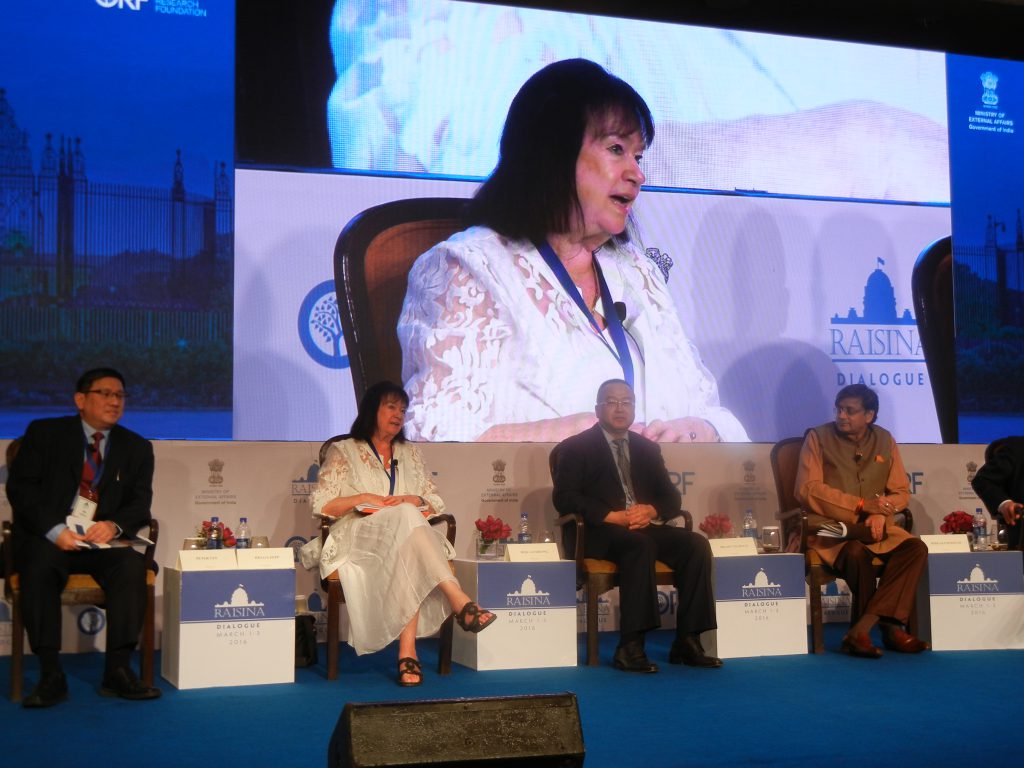
March 2, 2016 (Schiller Institute)–Helga Zepp-LaRouche, founder and Chairwoman of the Schiller Institute, spoke today in New Delhi at the Raisina Dialogue, co-sponsored by the Indian Ministry of External Affairs and the Observer Research Foundation. The two-day conference is described by its organizers as being “designed to explore prospects and opportunities for Asian integration as well as Asia’s integration with the larger world.” The event hosted more than 100 speakers from over 100 countries.
Helga Zepp-LaRouche’s Presentation (Video)
Helga Zepp-LaRouche’s Presentation (Audio)
For the first time the Indian Ministry of external affairs hosted together with the Observer Research Foundation (ORF) the Raisina Dialogue in New Delhi from the 1st to 3rd of March 2016.
The conference, with over 600 guests from over 100 nations, focused on Asia’s physical, economic, human and digital connectivity as well as the needed international partnerships to address the challenges in this century effectively.
The participation of speakers involved policy and decision makers, including cabinet ministers from various governments, high-level government officials and policy practitioners, leading personalities from business and industry, members of the strategic community, media and academia. Among the inaugural speakers were the Ministers of Foreign Affairs from Bangladesh and India, Abdul Hassan Mahmood Ali and Sushma Swaraj, and several former presidents: Hamid Karzai (Afghanistan), Chandrika Bandaranaike Kumaratunga (Sri Lanka), and Sir James Mancham (Seychelles). Furthermore the conference was addressed by the Indian Foreign Secretary S. Jaishankar, several other ministers of India, as well as Li Zhaoxing, former foreign minister of China. Ding Guorong, Senior Vice President of the Silk Road Fund, as well as many other incumbent and former politicians and last but not least the founder and head of the Schiller-Institute, Helga Zepp- LaRouche.
The panels addressed different aspects:
Under the title of “Wither European Union” the panelists, among them two members of European parliament dealt with the challenges of the Euro-zone with the refugee crisis and terrorism. Most of them blamed the lack of solidarity among the member states as the core reason to the crisis. In the Q&A session Helga Zepp-LaRouche could intervene by bringing in the only way how to solve the refugee crisis, the kind of Marshall Plan to rebuilt the whole region which was destroyed by all these wars. Even though the panelists did not respond directly to it, it made a huge effect and was brought up by another speaker later in the afternoon and in different side discussions. In her speech in the panel “Connecting a Continent: An Asian Union” Helga Zepp- LaRouche elaborated that idea in a much bigger context of the New Silk Road Process as the only means to avoid thermonuclear war. In the Q&A session she was able to elaborate her on her remarks and uplift the discussion into the strategic outlook.
Throughout the proceedings of the event many thankful and concerned people asked Mrs. Zepp-LaRouche to elaborate more on the issues she raised, especially on the war danger and the New Silk Road initiative.
Other panels included topics as “Asias Strategic Order”, which addressed the role of nuclear weapons vis-a-vis stability in the region, or “Waters of Asia”, which dealt with the transnational development of river basins and implications of energy corridors and international waterways. There were also several panels on different security items, one focussing on asymmetrical and sub-conventional security threats from state and non-state actors and how to respond to these.
The program to the conference can be found at: http://raisinadialogue.org