Autor: Mary Jane Freeman

Beethoven: Sparks of Joy

A Presidents Day tribute to G. Washington and A. Lincoln both of whom loved music: Beethoven’s Kreutzer sonata for violin and piano played by a master. The Kreutzer Sonata, Beethoven’s ninth for violin and piano, is sometimes referred to as “the other Ninth”. The story of its dedication is famous: The half-African violinist George Bridgetower […]

Read More

Beethoven: Sparks of Joy

Today, Beethoven’s second piece of Opus 49. We are eternally grateful to Beethoven’s brother Kaspar, who arranged for the publication, against the composer’s wishes, of the two „Leichte Sonaten“ Opus 49. There is hardly a piano student who has not learned from study of these graceful pieces. We present here the Opus 49 number 2, Beethoven’s […]

Read More

Beethoven: Sparks of Joy

Beethoven’s „Leichte Sonaten“ composed in 1795-76 but not released publicly until 1805 are often studied by students. The Opus 49 “Leichte Sonaten” (light sonatas) are only known today because Kaspar van Beethoven, one of the composer’s brothers, decided on his own to present them for publication in 1805, fully ten years after they had been […]

Read More

Beethoven: Sparks of Joy

Beethoven’s piano sonata Op. # 3 in E-flat major, „The Hunt,“ was written in 1802. The third of the Opus 31 sonatas is affectionately known as “The Hunt”, a nickname that describes only the last movement – fast, rollicking, and full of “horn calls”. This is one of Beethoven’s most good-natured works, displaying grace, charm, and […]

Read More

World Land-bridge: Creating a Human Future

Schiller Institute author, Hussein Askary, speaks to Nigerians: Africa will become the workshop of the world. On Feb. 4, Hussein Askary, a Schiller Institute member and co-author of its special report, Extending the New Silk Road to West Asia and Africa – a Vision of an Economic Renaissance, spoke to a webinar in Abuja, Nigeria. […]

Read More

Beethoven: Sparks of Joy

Beethoven’s „Tempest,“ Opus 31 #2 in D-minor. We come to one of the greatest sonatas in the entire repertoire, the Opus 31 #2 in D-minor, nicknamed “The Tempest”. From the unsettling eerieness of the opening movement, to the marvelous , orchestra-like setting of the Adagio second movement, and then the “moto perpetuo” Allegretto at the […]

Read More

Beethoven: Sparks of Joy

Beethoven’s Opus 31 piano sonatas began a new path for him. Beethoven composed his trio of Opus 31 piano sonatas in 1801-1802, after he had remarked to his student Carl Czerny that he was dissatisfied with his compositions so far and was setting out on a new path. Each of the sonatas is strikingly different, […]

Read More

Beethoven: Sparks of Joy

Beethoven, Franz Schubert: musical dialogue and the C-minor series. No investigation of the C-minor dialogue among composers can be complete without the astonishing C-minor sonata by Franz Schubert, whose birthday we recognized on January 31. Schubert, a native of Vienna, was 15 years Beethoven’s junior, although he died just one year after Beethoven at the […]

Read More

Beethoven: Sparks of Joy

Beethoven and the C-minor dialogue. We return to Beethoven with two of his best-known sonatas in C-minor: the Pathétique and the Opus 111. Listen for the development of the theme that Bach put forward in his Musical Offering! Sonata Pathétique (1st movement) played by Dubravka Tomsic: Opus 111 (1st movement) played by Alfred Brendel:

Read More

Beethoven: Sparks of Joy

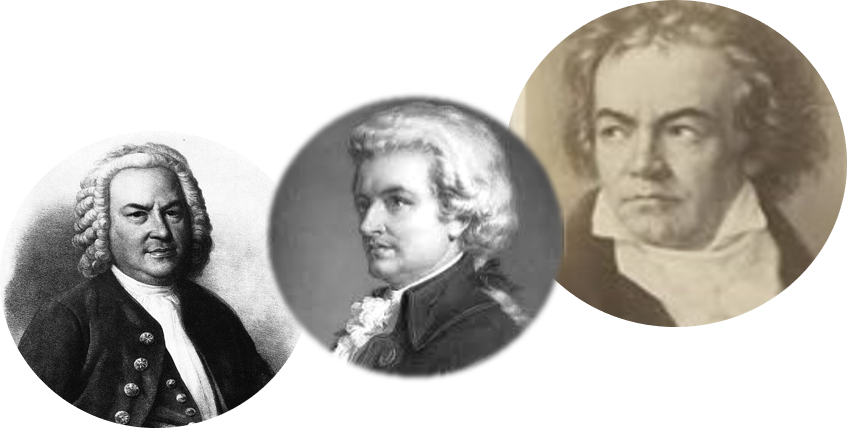
Beethoven, Mozart, Bach: A Musical Dialogue. We continue the investigation of the C-minor dialogue with Bach’s Ricercar à 6 and Mozart’s sonata K.457. When the elderly J.S. Bach visited his son who was court musician for Frederick II, the king presented the elder Bach with a difficult theme, and challenged him to improvise a three-part […]

Read More